
Designing a URL structure feels like one of those “measure twice, cut once” moments.
It seems trivial at first, but once you have 10,000 pages indexed and a marketing team breathing down your neck, changing your URL taxonomy is a migration nightmare you want to avoid.
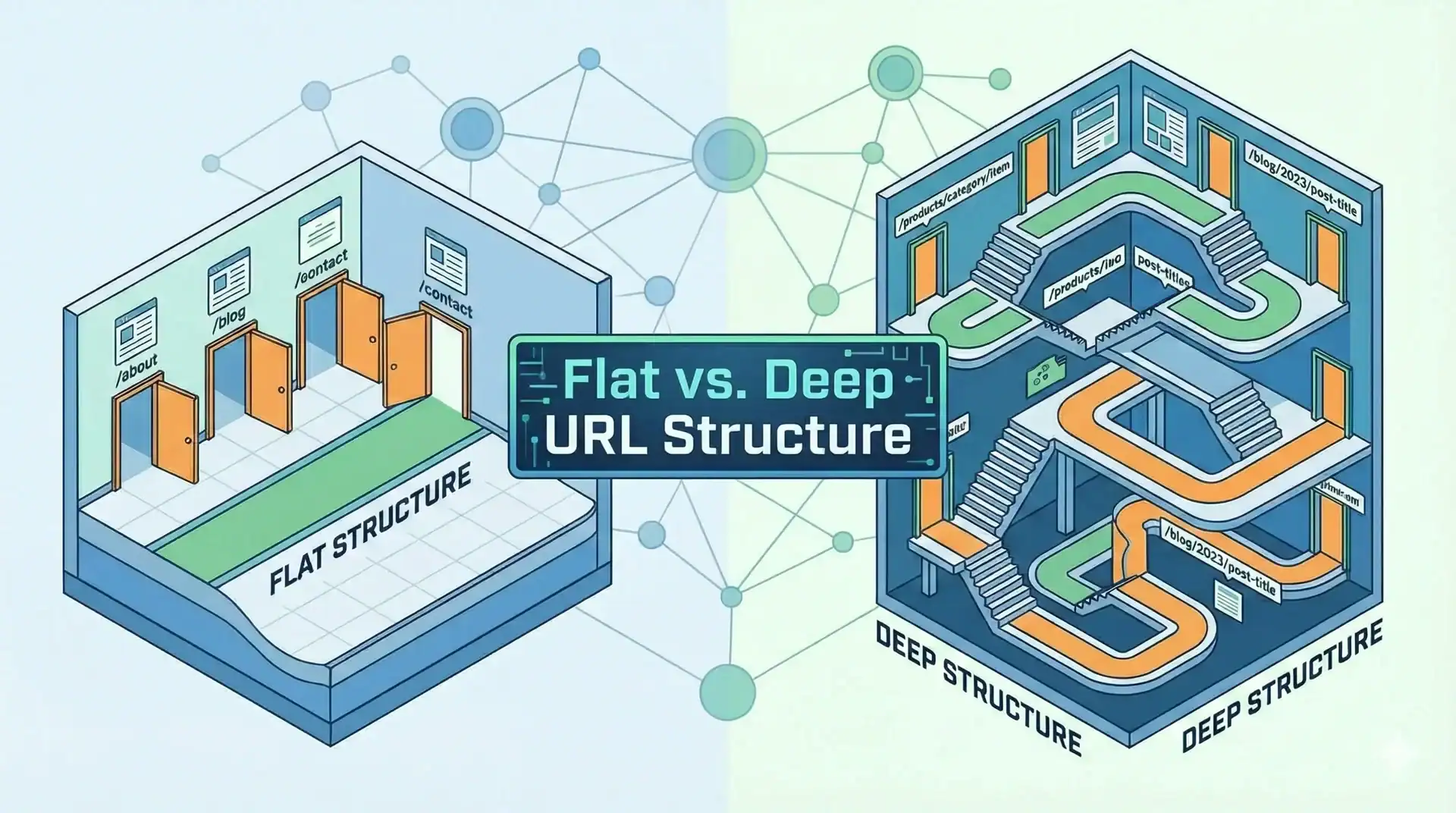
The debate usually lands on two distinct philosophies – Flat (everything at the root) vs. Deep (nested folders). Both have valid use cases, but they signal very different things to search engines and users.
Flat URL Structure
In a flat architecture, you strip away the directories. Every page sits directly off the root domain – example.com/page-slug.
The primary argument for going flat is Link Equity (or PageRank, for the old-school crowd).
Generally, the homepage has the highest authority on a domain. In a flat structure, every page is one “hop” away from that power source. There is no dilution as the crawler moves down a directory tree.
It also helps with Crawl Budget.
Googlebot and Bingbot are efficient, they don’t want to dig through six folders to find a blog post from 2021. Keeping content at the root ensures high visibility and faster indexation.
Namespace Collisions
The downside is organization. A flat structure works beautifully for a 30-page marketing site. It fails hard on a 5,000-page e-commerce platform.
If everything is at the root, you lose the ability to use URL patterns for routing logic or analytics segmentation.
You also run the risk of slug collisions – trying to create a blog post named “Services” when you already have a landing page with that slug.
Deep URL Structure
Deep architecture relies on a strict hierarchy. You use directories (or simulated directories) to categorize content logically – example.com/category/sub-category/page-slug.
Deep structures excel at Topical Authority. By nesting content, you are explicitly telling search engines how your data is related.
If you have a URL like /services/cloud-migration/aws, you are creating a semantic relationship. You are signaling that “AWS” is a subset of “Cloud Migration.”
This helps search engines understand the context of the page, not just its keywords. It allows you to build “silos” of relevance that can rank higher for broad terms than a scattered flat structure might.
In fact, On The Map grew a brand new store from $0 to $460k+ in revenue through URL structure optimizations. By forcing Google to understand the hierarchy (Parent > Child > Product), they dominated specific vertical keywords that a flat structure would have diluted.
And the UX argument? Breadcrumbs.
Deep URLs practically write their own breadcrumb trails. When a user looks at the address bar, they know exactly where they are. It mimics the file system logic we’ve all used for decades.
Routes are not Files
This is where many get tripped up. In the static HTML days, a deep URL meant you physically had a folder inside a folder on your FTP server.
Today, URLs are an abstraction.
If you are using a modern stack (Next.js, Laravel, Django, or even a headless CMS), your URL structure is defined in your routing configuration, not your file system.
- Deep files served flat – You might organize your code as
/pages/blog/2025/posts/article.js, but define a route that serves it atexample.com/article. - Flat files served deep – You can take a single dynamic template and serve it across endless nested categories based on database queries.
This decoupling gives you the freedom to choose the structure that fits the user and the bot, rather than the one that fits your GitHub repo.
Which one wins?
There is no “best” option, but there is a “correct” option for your specific constraints.
Stick to Flat (/slug) if:
- Authority is priority #1 – You are a news site or a high-impact blog where every article needs maximum ranking potential immediately.
- The site is small – If you have fewer than 500 pages, folders often add friction without adding value.
- You are a single-product SaaS –
yoursass.com/featuresis better thanyoursass.com/product/software/features.
In support of the argument for Flat, here is an interesting case study from Skroutz, a large Greek marketplace that had too many URLs. Their structure was arguably too deep and cluttered with infinite faceted navigation parameters, creating millions of low-value pages.
They blocked param-based URLs and reduced the number of indexed pages by 72%. This effectively “flattened” the crawlable web for the bot, ensuring only the high-value pages were accessible. The result – monthly sessions jumped to 30 million.
Go Deep (/cat/slug) if:
- You have distinct product lines – An e-commerce site needs
/mens/shoesand/womens/shoes. Flat structures here cause chaos. - You need “Wildcard” handling – If you want to handle all blog posts with a specific logic (like injecting a newsletter signup), it is much easier to target the route
/blog/*than to check every single URL against a database. - You are international – You absolutely need deep structures for localization (
/en-us/,/fr-ca/).
Final Advice
If you are on the fence, a Hybrid approach is usually the safe bet. Keep your “money pages” (Landing, Pricing, Contact) flat for maximum punch, and move your high-volume content (Blog, Products, Knowledge Base) into a deep structure to keep the house tidy.
Whatever you choose, commit to it. The only thing worse than a sub-optimal URL structure is one that changes every six months, leaving a trail of redirect chains in its wake.